
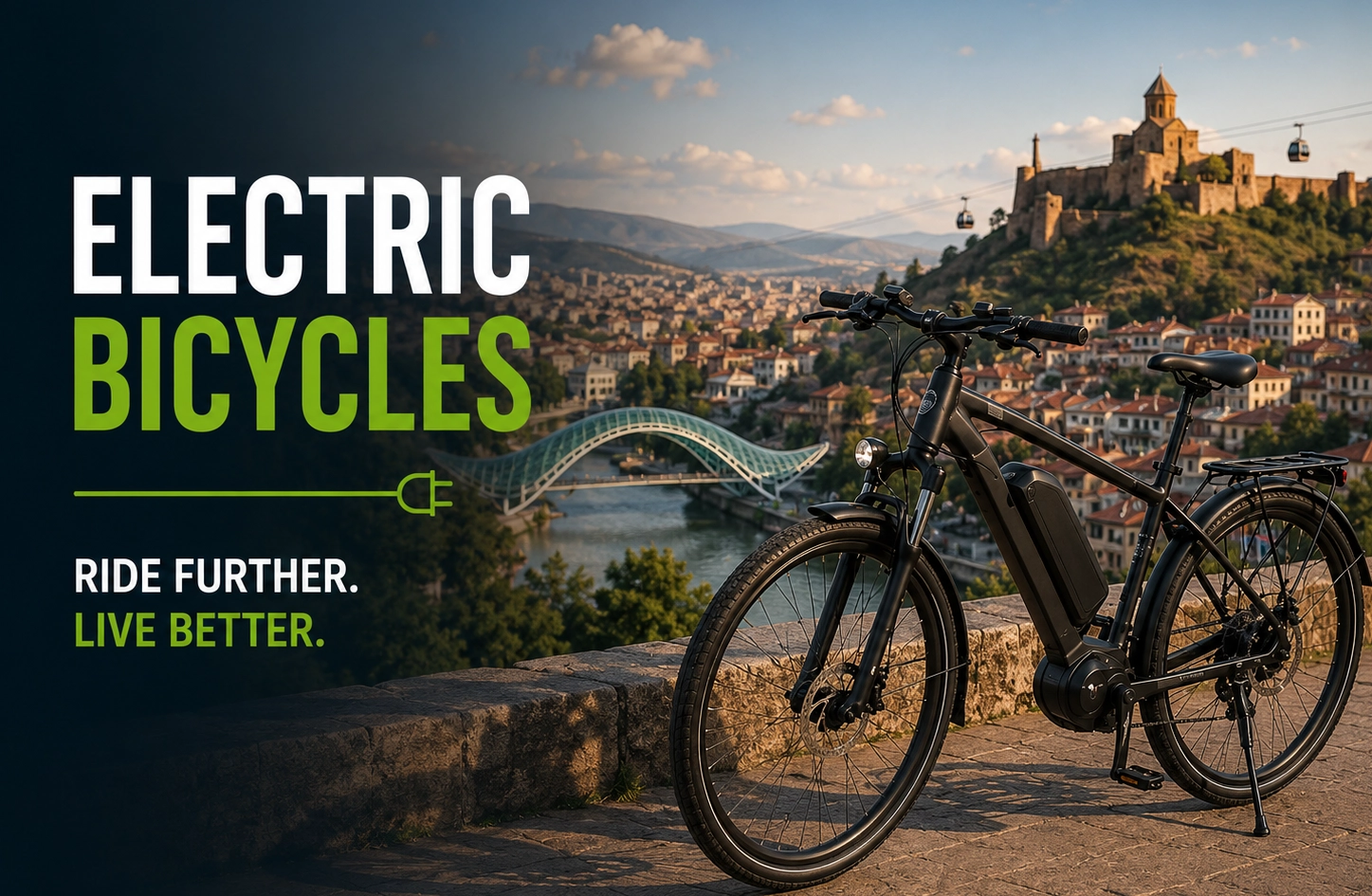
An electric bicycle is a conventional bicycle equipped with additional electrical components. It has an electric motor, a battery, a controller, and sensors that detect pedalling and, when needed, the electric motor provides the rider with additional assistance.
An electric bicycle does not eliminate the need for physical movement. On most models, the rider still needs to pedal, but riding uphill, into a strong headwind, with a heavy load, or over long distances becomes significantly easier.
In recent years, electric bicycles have become increasingly popular in many countries — for everyday urban transport, tourism, mountain routes, courier work, and cargo transport. Interest in them is also gradually growing in Georgia, and electric bicycles are being used more frequently for a variety of purposes.
How does an electric bicycle work?
An electric bicycle system combines several main components:
- an electric motor;
- a battery;
- a motor controller;
- sensors that detect pedal movement and pedalling force;
- a display or control buttons;
- electrical wiring.
When the rider starts pedalling, a sensor detects the movement and sends information to the controller. The battery then supplies energy to the motor, and the power generated by the motor is added to the rider’s own effort.
The rider can usually choose the level of assistance. In a low-assistance mode, the motor uses less energy and the battery lasts longer. In a high-assistance mode, riding becomes easier, but energy consumption also increases.
Many models have several modes, for example:
- eco mode;
- standard mode;
- sport mode;
- high-assistance mode.
The names of these modes may differ between manufacturers, but their purpose is generally similar.
Where are electric bicycles used?
Electric bicycles are used in different environments and for different purposes. Before choosing one, it is important to know where and how you plan to ride it.
Everyday urban transport
An electric bicycle is convenient for travelling from home to work, school, shops, or other everyday destinations.
One of its main advantages is that the rider spends less time in traffic, does not need a large parking space, and can cover several dozen kilometres with relatively little physical effort.
Electric bicycles are especially useful in hilly cities. Steep climbs are a major obstacle for many people on a conventional bicycle, while electric motor assistance makes such sections considerably easier.
This makes an electric bicycle an interesting option for Tbilisi as well, where there are significant differences in elevation between different parts of the city.
Travel outside the city
An electric bicycle can also be used for travelling between nearby settlements and towns.
In this case, particular attention should be paid to:
- the distance that can be covered on one charge;
- the climbs along the route;
- charging opportunities;
- the road surface;
- the presence and size of luggage.
When travelling outside the city, simply counting kilometres is not enough. Fifty kilometres on flat terrain and fifty kilometres in mountainous terrain place completely different demands on the battery.
Cycling tourism and travel
Electric bicycles are increasingly used on touring routes. They allow travellers to cover more distance in a day, climb hills more easily, and carry luggage at the same time.
Electric bicycles are especially useful for:
- multi-day trips;
- mountainous regions;
- travelling with heavy bags;
- groups whose members have different levels of fitness;
- people who are new to bicycle touring;
- older travellers.
On a group cycling tour, electric bicycles reduce differences in speed between participants. A less experienced or less fit rider can keep up with the group more easily and enjoy the route more.
For touring use, it is preferable for the battery to be easily removable, because at a hotel or guesthouse it is often more convenient to take only the battery indoors for charging.
Mountain routes
Electric mountain bikes are used on forest roads, trails, and steep climbs.
On such models, the motor is often positioned near the crank axle, in the lower central part of the frame. This distributes the bicycle’s weight more evenly and improves handling on difficult terrain.
Important features of an electric mountain bike include:
- a powerful and smooth-running motor;
- a wide-range drivetrain;
- powerful brakes;
- a durable frame and wheels;
- a high-quality suspension system;
- protection of the battery and motor from mud and water.
The electric motor makes climbing easier, but it cannot replace riding experience on descents. An electric bicycle is heavier than a conventional model, so greater care is required on fast and technically difficult descents.
Cargo transport
Electric bicycles are often used to carry groceries, parcels, work tools, and other cargo.
A cargo electric bicycle may be equipped with:
- a large rear rack;
- a front cargo compartment;
- an enclosed box;
- special panniers or bags;
- a seat or compartment designed for a child.
Such bicycles are used for courier services, small businesses, family transport, and everyday shopping.
When choosing a cargo bicycle, motor power is not the only important factor. You should also check the manufacturer’s permitted total weight limit, braking capability, frame strength, and battery capacity.
Transporting children
A child seat, a special trailer, or a family cargo compartment can be used with an electric bicycle.
Motor assistance is especially useful in this case because the combined weight of the child, seat, luggage, bicycle, and rider can be considerable.
For family use, it is preferable for the bicycle to have:
- a low-step frame that is easy to mount;
- a stable kickstand;
- powerful brakes;
- wheel and chain guards;
- smooth and gentle acceleration;
- good lighting;
- stable handling at low speed.
Courier work
Electric bicycles are particularly effective for courier work because frequent stops and repeated starts during the day become less tiring.
Important features of a courier bicycle include:
- a high-capacity battery;
- the ability to use a second battery;
- a durable cargo rack;
- puncture-resistant tyres;
- reliable brakes;
- affordable and accessible servicing.
For older and less active people
Electric bicycles help many people maintain an active lifestyle. Motor assistance reduces the effort required to climb hills and cover long distances.
In such cases, the following features are especially convenient:
- a low-step frame;
- a comfortable riding position;
- simple control buttons;
- a large, easy-to-read display;
- smooth and gentle motor engagement;
- powerful brakes.
In the case of significant health problems, the appropriate level of physical activity should be agreed with a doctor.
Why are electric bicycles becoming increasingly popular?
Several factors contribute to the growing popularity of electric bicycles.
Travel with less effort
The electric motor assists the rider on climbs, in strong winds, and when carrying heavy loads.
This is especially important for people who previously avoided cycling because of the physical effort involved.
With an electric bicycle, a person can:
- become less tired;
- cover longer distances;
- arrive at work less sweaty;
- overcome difficult climbs;
- use a bicycle more frequently in everyday life.
Covering longer distances
An electric bicycle expands travel possibilities: a distance that might seem difficult or excessively tiring on a conventional bicycle becomes more manageable with electric assistance.
For this reason, it can also replace a car or public transport, particularly on short- and medium-distance journeys.
Climbing hills more easily
In cities and regions with many hills, an electric bicycle is far more practical than a conventional model.
Climbing performance depends on:
- motor power;
- battery condition;
- the total weight of the bicycle;
- the gradient of the climb;
- the selected gear;
- the effort provided by the rider.
An electric bicycle cannot climb every hill without effort, but it significantly reduces the required exertion.
Saving time and money
The cost of charging and maintaining an electric bicycle is significantly lower than the cost of fuel and servicing for a car.
In urban travel, it can also save time because the rider does not have to sit in traffic or search for a parking space.
The main operating costs of an electric bicycle include:
- electricity required to charge the battery;
- periodic tyre repair or replacement;
- replacement of brake pads;
- maintenance or replacement of the chain and sprockets;
- periodic technical inspection and servicing;
- battery replacement after long-term use.
An electric bicycle is not a cost-free means of transport, but for everyday travel it is far more economical than a car.
Avoiding traffic jams and parking problems
Covering a short distance by car in a city can sometimes take a long time. It is easier to move through congestion by bicycle, far less space is needed for parking, and there is no need to search for a parking place.
Technological development
Modern electric bicycles are lighter, quieter, and more efficient than models available several years ago.
The following have improved:
- battery capacity;
- motor size;
- smooth delivery of assistance;
- battery condition monitoring;
- displays and control buttons;
- integration of the battery and motor into the frame;
- anti-theft features;
- the ability to connect to a mobile phone.
Some modern electric bicycles are now almost indistinguishable in appearance from conventional bicycles.
Accessibility for people with different physical abilities
Electric bicycles allow people with different levels of fitness to travel together.
For example, in a family or group of friends, a more experienced participant may ride a conventional bicycle, while a less experienced rider uses an electric bicycle.
This reduces speed differences within the group and makes cycling accessible to more people.
Encouraging an active lifestyle
Riding an electric bicycle still requires physical activity. The rider chooses how much assistance is needed.
Many people ride more frequently and cover longer distances on an electric bicycle than they would on a conventional bicycle. As a result, their overall level of physical activity may increase.
Lower environmental impact
An electric bicycle produces no exhaust emissions while being ridden and requires far less energy than a car.
Its environmental impact is not completely zero, because battery production and recycling require resources. Nevertheless, when an electric bicycle replaces a car journey, the environmental benefit can be significant.
Types of electric motors
Electric bicycle motors are mainly found in two locations.
Hub motor
The motor may be positioned in the centre of either the front or rear wheel.
Rear-hub motors are widely used on urban and relatively affordable models.
Their advantages include:
- simple construction;
- relatively low cost;
- less strain on the drivetrain;
- simple everyday use.
A disadvantage is that the wheel containing the motor is heavy, and changing the tyre or inner tube may be more difficult.
Front-hub motors are less common. On wet or loose surfaces, the front wheel may lose traction more easily.
Mid-drive motor
In this system, the motor is located near the crank axle, in the lower central part of the frame.
The motor uses the bicycle’s drivetrain, making it especially effective:
- on steep climbs;
- on mountain routes;
- when carrying cargo;
- when riding at low speed on difficult sections.
With this arrangement, the bicycle’s weight is distributed more evenly and the handling feels more natural.
A disadvantage is that the power of the motor and the rider is transferred through the chain and sprockets at the same time. As a result, the chain and rear cassette may wear out more quickly.
When changing gear, it is advisable to reduce pressure on the pedals briefly. Shifting under full load can damage the chain or sprockets.
Motor power and torque
Electric bicycle motor power is measured in watts (W). Technical specifications often list two values:
- nominal power — the power the motor can produce continuously and reliably;
- maximum power — the power the motor can produce for a short period, for example during acceleration or while climbing.
When evaluating motor performance, torque is also important. It is measured in newton-metres (Nm). The higher this figure, the more effectively the motor can assist the rider.
Therefore, when choosing an electric bicycle, motor power alone should not be the only consideration — torque also has a major effect on real-world performance.
High torque is especially noticeable:
- when starting from a standstill;
- on steep climbs;
- when carrying a heavy load;
- when riding at low speed.
Moderate torque is often sufficient for urban use, while mountain and cargo bicycles may require a more powerful system.
Pedal sensors
Electric bicycles mainly use two types of sensors.
Cadence sensor
This sensor detects whether the pedals are turning. When it detects movement, it activates the motor.
Such a system:
- is relatively inexpensive;
- has a simple design;
- is often sufficient for urban riding.
In some cases, the motor engages with a slight delay and the assistance may feel relatively abrupt.
Torque sensor
This sensor measures how much force the rider applies to the pedals.
If the rider pedals lightly, the motor provides light assistance. If the rider pushes harder while climbing, the level of assistance increases.
This type of system feels more natural and is especially enjoyable on urban, touring, and mountain bicycles.
Battery
The battery is one of the most important and expensive components of an electric bicycle.
When evaluating a battery, three measurements should be considered:
- voltage — volts;
- capacity — ampere-hours;
- total energy — watt-hours.
The most useful measurement for comparing different batteries is the watt-hour.
For example:
36 volts × 14 ampere-hours = 504 watt-hours.
The higher the number of watt-hours, the more energy the battery can store. However, a larger battery is also heavier and more expensive.
Comparing ampere-hours alone is incorrect, because batteries with different voltages may have the same ampere-hour rating while storing different amounts of energy.
How many kilometres can an electric bicycle cover on one charge?
The distance that can be covered on one charge depends on many factors.
These include:
- battery capacity;
- the selected assistance mode;
- the weight of the rider and luggage;
- the number of climbs;
- wind;
- road surface;
- tyre pressure;
- air temperature;
- the effort provided by the rider;
- motor efficiency.
With the same battery, it may be possible to cover a significantly greater distance on flat terrain than on a mountainous route.
The range stated by the manufacturer is often measured under ideal conditions. In real-world use, the distance may be shorter.
If the route contains many climbs, you ride at high speed, or you use a high-assistance mode, the battery will discharge more quickly.
Battery charging and care
The battery should always be charged with the correct charger.
The fact that another charger’s plug fits the battery does not mean it is safe to use. Incorrect voltage or an unsuitable charging method can damage the battery or cause a fire.
When charging, it is advisable to ensure that:
- the battery is in a dry and well-ventilated place;
- the charger is placed on a non-flammable surface;
- there are no easily flammable materials nearby;
- a damaged cable or charger is not used;
- the battery is not left unattended for a long period;
- charging does not take place in extreme heat or freezing conditions.
The battery should not be charged if:
- the casing is swollen;
- it shows signs of a strong impact;
- it becomes unusually hot;
- there is a burnt or chemical smell;
- the contacts are burnt or melted;
- the battery has been submerged in water.
During long-term storage, it is not advisable to leave the battery fully charged or completely discharged. A medium state of charge and a dry environment with a moderate temperature are preferable.
Brakes and tyres
An electric bicycle is heavier than a conventional bicycle. It also often has a higher average speed, so brake quality is especially important.
High-quality disc brakes are recommended, particularly:
- on mountain bicycles;
- on cargo models;
- when transporting a child;
- on long descents;
- for heavier riders or when carrying luggage.
Tyres should be suitable for the bicycle’s weight and intended use.
Attention should be paid to:
- tyre durability;
- grip on wet roads;
- puncture protection;
- correct pressure;
- permitted load.
Very low tyre pressure increases energy consumption, while excessively high pressure reduces comfort and grip.
How to choose an electric bicycle
Before choosing an electric bicycle, you should answer several basic questions:
- Where will you use the bicycle?
- Approximately how many kilometres will you ride per day?
- Are there steep climbs on your route?
- Will you carry luggage?
- Do you need the battery to be easily removable?
- Where will you be able to charge it?
- How important is the bicycle’s weight?
- Are spare parts and servicing available?
For urban use
For urban use, the following are often sufficient:
- a medium-capacity battery;
- a hub motor or a mid-drive motor;
- a comfortable riding position;
- lights;
- mudguards;
- a rear rack;
- reliable brakes.
For a hilly city
In hilly conditions, the following are preferable:
- a mid-drive motor;
- high torque;
- a torque sensor;
- a wide range of low gears;
- a relatively large battery.
For touring
For touring use, the following are important:
- long range;
- a removable battery;
- a comfortable frame;
- mounting points for bags and racks;
- availability of spare parts;
- the ability to carry a standard charger.
For mountain routes
On an electric mountain bike, attention should be paid to:
- motor performance on climbs;
- battery capacity;
- the suspension system;
- the brakes;
- the tyres;
- frame size and fit;
- the total weight of the bicycle.
Buying a used electric bicycle
When buying a used electric bicycle, the main risk is the condition of the battery.
A battery may look good and charge fully, while storing far less energy than it did when new.
Before buying, it is advisable to check:
- the age of the battery;
- the real-world distance covered on one charge;
- whether the charger is correct and compatible;
- motor noise;
- error messages on the display;
- the condition of the battery casing;
- the condition of connectors and contacts;
- wear on the chain and sprockets;
- the condition of the brakes;
- the price and availability of a replacement battery.
The best test is a trial ride, especially on a climb and in a high-assistance mode. If the battery suddenly shuts down under load or the charge level drops quickly, it may be significantly worn.
Common mistakes
“The more watts, the better”
This is not always true. Motor quality, position, torque, battery, and the control system are all important.
“A larger battery is always better”
A larger battery provides more range, but it also makes the bicycle heavier and more expensive.
“You do not need to pedal an electric bicycle”
On many models, the motor works only while the rider is pedalling. An electric bicycle is not a motorcycle.
“The range is always the same”
Range varies significantly depending on terrain, weather, weight, and the selected assistance mode.
“Any charger can be used”
Using the wrong charger is one of the most dangerous mistakes. A charger with the correct voltage and type is required.
Electric bicycles on the CCN Bike Market
People interested in buying an electric bicycle can view and compare different models on the CCN Bike Market.
On the Bike Market, you can browse new and used electric bicycles and compare prices, intended use, frame size, motor type, and battery specifications.
When reviewing a listing, pay attention not only to the bicycle’s appearance and motor power, but also to battery condition, real-world range, brakes, frame size, and the availability of spare parts.
Conclusion
An electric bicycle is a practical means of transport for urban travel, touring, mountain routes, family transport, and carrying cargo.
Its main advantage is that it makes cycling accessible to more people. It reduces the difficulty caused by hills, long distances, and heavy loads, while still requiring the rider to participate.
When choosing the right model, the number of watts shown on the motor should not be the only consideration. Important factors include:
- motor position;
- torque;
- battery capacity;
- real-world range on one charge;
- brakes;
- bicycle weight;
- permitted load;
- availability of servicing and spare parts.


Comments (1)